In the production of custom fasteners, non-standard fasteners and drawing-based metal components, many customers choose full CNC machining when they receive a new drawing. This is especially common for parts with heads, steps, holes, grooves, chamfers or special external shapes.
At first glance, these parts may look too complex for forming processes and seem to require turning, milling and drilling from solid bar stock. However, full CNC machining is not always the most cost-effective manufacturing route.
For stable-volume parts with a suitable structure, a better solution may be to combine cold heading, cold forming and CNC machining. By using cold heading pre-forming to create the main external shape and keeping CNC machining only for critical functional dimensions, manufacturers can often reduce material waste, shorten machining time and improve batch consistency.
This case study shows how we helped a customer optimize an automotive stepped bushing from full CNC machining to cold heading + CNC finishing, reducing cost by about 40% while improving production efficiency.
Customer Product Background
The customer’s product was a stepped bushing used in an automotive application. The part had several structural features:
- Two stepped surfaces requiring accurate fit with mating components
- An internal hole used for positioning
- General external diameter requirements
- A relief groove on the step
- Stable step height requirements
- Stable batch production demand
The original process was full CNC machining from round steel bar stock. This process could meet the drawing requirements, but as order volume increased, the customer faced several problems:
- Long machining time
- High material waste
- High tool consumption
- Higher unit cost
- Longer production lead time
For the customer, the issue was not only the purchase price. It was also about long-term manufacturing cost, production efficiency and supply stability.
Original Manufacturing Process
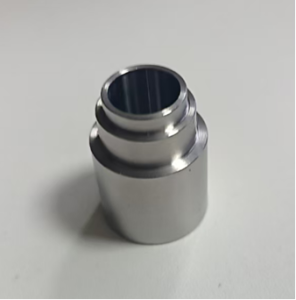
The original production route was:
Round steel bar stock → Cutting → CNC rough turning → CNC drilling → Turning steps and relief groove → Cleaning → Inspection → Packing
From a manufacturing point of view, the main problems were clear.
1. High Material Removal
Because the internal hole, stepped surfaces and external profile were all produced by CNC machining, the part had to start from larger-diameter bar stock. A large amount of material was removed as chips.
This increased both material cost and machining time.
2. Long CNC Machining Cycle
The more complex the part profile, the more CNC operations are needed. Rough turning, finishing, drilling, chamfering and groove machining all increased the cycle time.
For batch production, machining cycle time directly affects capacity, lead time and total cost.
3. High Tooling and Cutting Tool Consumption
When the cutting allowance is large, tool wear increases quickly. Tooling cost is only one part of the problem. More importantly, frequent tool changes, machine adjustment, size compensation and process variation can create hidden production costs.
4. Batch Consistency Challenges
In CNC machining, dimensional stability may be affected by tool wear, clamping condition, machine condition and operator habits.
For batch production, too many machining steps also increase inspection pressure and process control requirements.
5. High Overall Unit Cost
From the customer’s side, the first concern was simply that the price was high. But after process analysis, we found that the real cost drivers were material waste, long machining cycle time, multiple operations and high tool consumption.
Process Review: Not Every Dimension Needs CNC Machining
After reviewing the drawing, we found that although the part was a stepped bushing, not every dimension was a critical functional dimension.
We divided the part dimensions into two groups.
Critical Functional Dimensions
These dimensions directly affected assembly and performance, so they still needed to be controlled by CNC machining or other finishing processes.
Examples included:
- Step outer diameter
- Step height
- Internal hole size
- Relief groove
- End face perpendicularity
- Specific chamfers
- Fitting surfaces in direct contact with mating parts
These areas could not be simplified only for cost reduction. They needed to continue meeting the drawing requirements.
Non-Critical External Shape Dimensions
Other dimensions mainly served connection, positioning, transition or general structural functions. They did not directly affect the core assembly accuracy.
Examples included:
- General outer diameter
- Some transition radii
- Non-fitting external sections
- Overall blank profile
If all these areas were produced by CNC machining, the customer would continue paying for unnecessary material removal and machining time.
After evaluation, we determined that these external shapes could be produced by cold heading pre-forming.
This meant the part was suitable for process optimization from full CNC machining to cold headed blank + CNC finishing.
Optimized Manufacturing Process
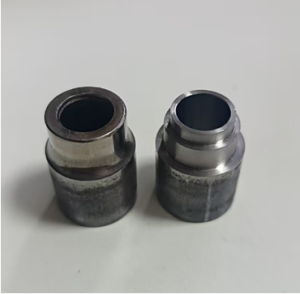
The optimized process became:
Wire rod material → Multi-station cold heading pre-forming → CNC finishing of internal hole and critical stepped areas → Cleaning → Inspection → Packing
The core idea was simple:
Cold heading forms the main external shape. CNC machining controls the critical dimensions.
In this process, cold heading creates the main body, outer profile and stepped blank shape as close as possible to the final part. CNC machining is then used only where precision is truly required, such as the internal hole, fitting step surface and step height.
This allows both processes to do what they are best at:
- Cold heading improves material utilization and production efficiency.
- CNC machining ensures dimensional accuracy for critical features.
Before and After Process Comparison
| Item | Original Process: Full CNC Machining | Optimized Process: Cold Heading + CNC Finishing |
|---|---|---|
| Blank source | Round steel bar stock | Cold headed wire blank |
| External shape | Mainly produced by turning | Mainly produced by cold heading |
| Material utilization | About 30% | About 95% |
| CNC machining content | Full external shape and critical dimensions | Only critical dimensions |
| Machining cycle time | About 90 seconds per piece | About 30 seconds per piece |
| Tool consumption | Very high | Lower |
| Number of operations | 8 | 6 |
| Batch consistency | More affected by tool wear | More consistent due to die forming |
| Initial investment | No cold heading tooling | Requires cold heading tooling |
| Suitable application | Small batches and prototypes | Stable medium and high-volume orders |
This comparison shows that cold heading does not simply replace CNC machining. Instead, it allows a better division of work between forming and machining.
For stable batch production, the tooling cost can be amortized over the order quantity, making the unit cost advantage much more significant.
Main Sources of Cost Reduction
1. Improved Material Utilization
In the original full CNC process, the internal hole and stepped profile were created by cutting from solid bar stock. This caused a large amount of material to become chips.
After switching to cold heading, the main external shape was formed through plastic deformation. Much less material was removed, which greatly improved material utilization.
2. Shorter CNC Machining Time
After optimization, CNC machining no longer handled most of the external forming work. It focused only on critical fitting dimensions.
This reduced rough machining time, shortened tool paths and improved machine utilization.
3. Lower Cutting Tool Consumption
With less material to remove, cutting tool wear was reduced. Tool life improved, tool changes became less frequent and dimensional variation during production was reduced.
4. Better Batch Consistency
Cold heading is a die-based forming process suitable for stable batch production. With proper tooling design and stable material conditions, the external shape consistency is usually better than repeatedly cutting the full shape by CNC machining.
5. Shorter Production Lead Time
Cold heading is efficient for batch forming. After CNC machining was limited to critical dimensions, the total production cycle improved significantly.
For the customer, this meant more stable delivery and stronger supply support.
Final Improvement Results
Through the optimized process, the production cycle time improved from about 90 seconds per piece to about 30 seconds per piece.
The total cost was reduced by approximately 40%.
This helped the customer improve production efficiency, reduce long-term purchasing cost and secure a more stable supply for its core product.
Value We Created for the Customer
In this case, we did not simply quote according to the drawing. Instead, we reviewed the part structure from a manufacturing process perspective and helped the customer find a more suitable production route for batch production.
Our value was mainly reflected in three areas.
1. Identifying the Real Cost Drivers
The customer initially saw the problem as a high unit price. After process review, we found that the real cost came from material waste, long CNC machining time, high tool consumption and too many process steps.
2. Reallocating the Manufacturing Process
We moved non-critical external forming to cold heading and kept the critical functional dimensions for CNC finishing.
This allowed each process to create value in the right place.
3. Achieving Long-Term Cost Reduction
For stable-volume products, this solution not only reduced unit cost, but also improved production consistency, delivery reliability and overall supply efficiency.
Manufacturing Support for Fastener and Component Suppliers
This case is also a good example of how we support overseas manufacturers, custom fastener suppliers, CNC machining shops, cold heading companies and OEM component suppliers.
Many local manufacturers already have strong production capabilities. However, some parts may be inefficient, expensive or difficult to produce in-house. In these situations, we can work as an additional manufacturing source.
We can support customers with:
- Supplementary production capacity
- Cost reduction for repeat custom parts
- Cold headed parts
- Cold formed components
- CNC machined fasteners
- Drawing-based fasteners
- Made-to-print metal components
- Secondary machining operations
- Special bolts, studs, pins, bushings, spacers and washers
- Parts that are difficult to source from standard catalogs
Our goal is not only to supply parts, but also to help customers review the manufacturing route and find a more cost-effective process when the part design and order volume are suitable.
Who This Solution Is Suitable For
This type of process optimization may be suitable for:
- Custom fastener suppliers
- Cold heading and cold forming companies
- CNC machining shops
- Metal stamping and welded assembly manufacturers
- Industrial component suppliers
- Automotive component suppliers
- Agricultural equipment parts suppliers
- Mining and heavy equipment parts suppliers
- Trailer and truck parts suppliers
- Small and mid-sized OEM manufacturers
If your current part is fully CNC machined but has stable volume and a suitable structure, we can help review whether cold heading, cold forming or a combined process can reduce cost.
Request a Manufacturing Review
If you have a drawing-based fastener, bushing, pin, spacer, stud, special washer or custom metal component that is expensive to machine, please send us your drawing, sample or purchasing list.
We will review the part carefully and evaluate whether a process such as cold heading + CNC finishing can help reduce cost, improve efficiency and support stable production.
Related Manufacturing Support
Custom Cold Headed Parts & CNC Machined Fasteners for Local Manufacturers
Learn how we support custom fastener suppliers, cold heading companies, CNC machining shops and local manufacturers with drawing-based metal parts, secondary operations and supplementary production capacity.