For many custom fastener suppliers, CNC machining shops, cold heading companies, and OEM component suppliers, the real challenge is not only finding a factory that can make a part. The more important question is whether the part can be made in a more efficient way.
At WJ Fastener, we often receive drawings for non-standard fasteners, custom bolts, and special metal components that were originally designed around machining. In some cases, this is necessary. In other cases, part of the machining work can be replaced by cold heading, cold forming, or split die forming.
This case study shows how a non-standard shaped connector was reviewed and optimized by changing the production route from “cold heading + secondary machining” to “cold heading + split die forming.” The goal was not simply to quote a lower price, but to reduce unnecessary processing, improve material utilization, and make the part more suitable for stable batch production.
Project Background: A Custom Shaped Connector with Thin Middle and Thick Ends
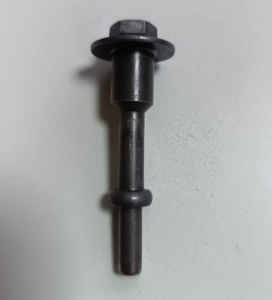
The part in this case was a special connector similar to a non-standard bolt. It was not a catalogue fastener and could not be produced efficiently with a standard bolt manufacturing process.
The main structural features included:
- A head and flange structure at the top
- A shaft section with a thinner middle area
- Locally thicker sections near both ends
- A positioning bulge in the middle area
- A threaded section at the bottom
- Overall geometry similar to a custom shaped bolt or special connector
This type of part is common in automotive components, machinery assemblies, construction equipment, electrical hardware, and industrial connection systems. For local fastener manufacturers or OEM component suppliers, it may look simple at first, but the shaft geometry can make the manufacturing route expensive if too much material is removed by machining.
For WJ Fastener, this is a typical drawing-based fasteners and made-to-print fasteners project. The customer provides a drawing, sample, or purchasing list, and we review not only the dimensions, but also the possible production method.
Original Process: Cold Heading + Secondary Machining
The original production route used by the customer was:
Wire cutting → 4-station cold heading → machining the thin middle shaft → thread rolling → heat treatment → surface treatment → inspection and packing
In this process, cold heading was used to form the head, flange, and basic blank shape. However, the thinner middle shaft, local thick areas, and positioning bulge were mainly created through secondary machining.
This method can work, especially during early development or low-volume production. CNC machining gives flexibility and allows the factory to make small batches without investing heavily in tooling.
However, when the order becomes stable and the quantity increases, the machining portion may become the main cost driver.
Problems with the Original Manufacturing Route
After reviewing the part and its production flow, several cost and efficiency issues became clear.
First, machining the middle shaft required additional cycle time. Every part had to be clamped, cut, and checked. Even if the machining operation was not very complex, the accumulated time became significant in batch production.
Second, material utilization was not ideal. The original blank needed enough material for the largest diameter sections, and then material was removed to create the thinner middle area. This is common in machining, but it is not always efficient for high-volume fastener production.
Third, the process required more transfers between machines and operators. Every additional operation means more handling, more waiting time, and more production control work.
Fourth, batch consistency could be affected by tool wear, clamping accuracy, machine condition, and operator setup. For parts with long shaft sections and local diameter changes, maintaining stable dimensions through machining can require frequent monitoring.
Finally, the total unit cost was relatively high. The issue was not only the machining cost itself, but the combined cost of material loss, labor, machine time, transfers, inspection, and production management.
For customers such as custom fastener suppliers, CNC shops, and OEM component suppliers, these hidden costs matter. A part may be technically manufacturable, but still not competitive enough for repeat orders.
Process Review: From Material Removal to Die Forming
The key question in this project was simple:
Can the middle shaft shape be formed instead of machined?
In the original route, the thin middle section was produced by removing material. In the optimized route, WJ Fastener reviewed the possibility of forming this geometry through die forming, especially split die forming or closed die forming.
The core idea was to change the manufacturing logic from material removal to plastic deformation.
Cold heading would still be used to form the head, flange, and initial shaft blank. Then, instead of cutting away the middle shaft area, a split die or closed die would be used to shape the thin middle, thicker end sections, and local bulge.
This is where experience with cold headed parts, cold forming, tooling design, material behavior, and batch production becomes important. The drawing cannot be reviewed only from the machining point of view. It must be checked from the forming point of view:
- Is the material suitable for forming?
- Can the diameter transition be controlled?
- Is the tolerance realistic for die forming?
- Will the bulge area fill properly?
- Can the part release smoothly from the die?
- Is the order quantity enough to justify tooling investment?
When these points are reviewed correctly, process optimization can create real cost advantages without reducing functional performance.
Optimized Process: Cold Heading + Split Die Forming
After review, the proposed optimized production route was:
Wire cutting → cold heading → split die forming for the shaped shaft → heat treatment → surface treatment → inspection and packing
The cold heading process forms the top head, flange, and basic blank. Then the shaft geometry is completed through split die forming. The middle thin section, two thicker local sections, and positioning bulge are formed by controlled material flow inside the die.
For threaded areas, the exact process depends on the drawing, material, tolerance, and thread specification. In some cases, thread rolling remains as a short and stable operation. In other cases, the overall forming sequence can be adjusted to reduce additional processing. The final route is always confirmed based on the actual part drawing and functional requirements.
The important improvement is that the most time-consuming shaft machining operation can be reduced or removed.
Before and After Process Comparison
Original process:
Wire cutting → cold heading → machining → thread rolling → heat treatment → surface treatment → inspection
Optimized process:
Wire cutting → cold heading → split die forming → heat treatment → surface treatment → inspection
The difference looks small on paper, but in production it can be significant.
Machining is flexible, but it is usually slower and more labor-dependent. Forming requires tooling, but once the tooling is stable, it is more efficient for repeat production.
This is why WJ Fastener does not treat every project as a simple quotation request. For custom metal components, custom shaped fasteners, and non-standard bolts, we review whether the part is better suited for machining, cold heading, cold forming, die forming, or a combined process.
Main Sources of Cost Reduction
The estimated unit cost reduction for this type of part can reach approximately 30%–35%, depending on material, size, tolerance, quantity, and tooling design. This is not a guaranteed saving for every project, but it is a realistic improvement range when the geometry and production quantity are suitable.
The main sources of cost reduction include:
Reduced secondary machining
The most direct saving comes from reducing the machining time required for the middle shaft. Less machining means shorter production cycles and lower machine-hour cost.
Better material utilization
Instead of cutting away material from a larger blank, the shaft shape is created through forming. This helps reduce waste and improve material efficiency.
Lower labor and transfer cost
Removing one major operation reduces handling, scheduling, and inspection work between processes.
Improved batch consistency
Die forming can provide more stable repeatability for formed diameters and local shapes when the tooling is correctly designed and maintained.
Better production efficiency
For stable orders, forming is usually faster than machining each part one by one.
Tooling cost can be spread over quantity
Split die tooling requires upfront investment. However, for repeat orders or medium-to-high volume batches, the tooling cost can be amortized across the order quantity.
This is especially valuable for overseas customers who need supplementary production capacity but do not want to overload their own machines with inefficient special parts.
Key Control Points in Split Die Forming
Although split die forming can reduce cost, it is not a simple replacement for machining in every case. Several technical points must be controlled carefully.
Material selection
The material must have suitable cold forming performance. Different steel grades, stainless steels, and alloy materials behave differently during deformation.
Diameter transition design
Sharp transitions may cause forming difficulty, stress concentration, or die wear. Radius design and transition geometry should be reviewed before tooling.
Tolerance requirements
Some dimensions are suitable for die forming, while very tight tolerances may still require light finishing or calibration. The production route should match the real functional requirement, not only the drawing habit.
Tooling structure
The split die must allow proper material flow and part release. Poor tooling design can create flash, underfill, surface marks, or unstable dimensions.
Production quantity
For prototypes or very small batches, CNC machining may still be more economical. For repeat orders, tooling-based forming usually becomes more attractive.
Inspection plan
Key dimensions such as middle diameter, bulge position, overall length, thread area, and flange size should be controlled with a clear inspection standard.
These control points are part of WJ Fastener’s manufacturing review. We are not only producing parts from drawings. We also help customers identify where the process can be improved before mass production.
Suitable Parts for This Process
Cold heading combined with split die forming is suitable for many types of custom fasteners and special metal parts, especially when the part has:
- Head, flange, or collar features
- A shaft with different diameters
- Local ribs, bulges, or positioning sections
- Non-standard bolt geometry
- High machining cost in the original route
- Stable repeat demand
- Requirements for better material utilization
- A need to reduce CNC machining workload
Typical applications include special connectors, stepped bolts, flange bolts, locating pins, shaft-type fasteners, automotive fasteners, machinery connection parts, and industrial assembly components.
For custom fastener suppliers, this process can help expand product capability without adding new forming lines in-house. For cold heading companies, it can support special geometries outside their current tooling capacity. For CNC machining shops, it can reduce the burden of producing high-volume turned fastener blanks. For local manufacturers and industrial distributors, it provides an outsourced route for parts that are difficult to produce competitively at home.
Manufacturing Support for Fastener and Component Suppliers
WJ Fastener is a China-based manufacturer of custom fasteners, non-standard fasteners, cold headed parts, and custom metal components. Our role is not limited to supplying standard screws, bolts, nuts, and washers.
We support overseas customers with:
- Drawing-based manufacturing
- Made-to-print fastener production
- Custom bolt and special connector manufacturing
- Cold heading and cold forming production
- Split die forming and die forming solutions
- Secondary operation support
- Cost review and process optimization
- Supplementary production capacity for local factories
- Outsourcing support for parts that are inefficient to make in-house
Many customers do not come to us only because they need a cheaper part. They come because their own production line is busy, their machining cost is too high, or a special component does not fit well into their standard process.
In these cases, WJ Fastener can work as a manufacturing partner behind the customer’s supply chain. We help review drawings, suggest practical production routes, and manufacture parts according to agreed specifications.
Request a Drawing Review
If you are working with custom shaped fasteners, drawing-based fasteners, made-to-print fasteners, or special metal components that require too much machining, WJ Fastener can help review whether cold heading, cold forming, split die forming, or another optimized process may reduce cost.
You can send us:
- 2D or 3D drawings
- Samples
- Material and surface treatment requirements
- Annual quantity or batch quantity
- Current process or purchasing list
- Key tolerance and application information
Our team will review the part from a manufacturing point of view and suggest a practical production route.
For overseas fastener suppliers, cold heading manufacturers, CNC machining shops, OEM component suppliers, and small-to-medium industrial manufacturers, WJ Fastener provides cost-effective custom manufacturing support from China.
Contact WJ Fastener at www.wjfastener.com to send your drawings, samples, or purchasing lists for review.
Related Manufacturing Support
Custom Cold Headed Parts & CNC Machined Fasteners for Local Manufacturers
Learn how we support custom fastener suppliers, cold heading companies, CNC machining shops and local manufacturers with drawing-based metal parts, secondary operations and supplementary production capacity.
Related Cost Reduction Case
Cost Reduction Case Study: From Full CNC Machining to Cold Heading + CNC Finishing
See another process optimization case showing how a stepped bushing was converted from full CNC machining to cold heading pre-forming + CNC finishing to reduce cost and improve production efficiency.
“`